
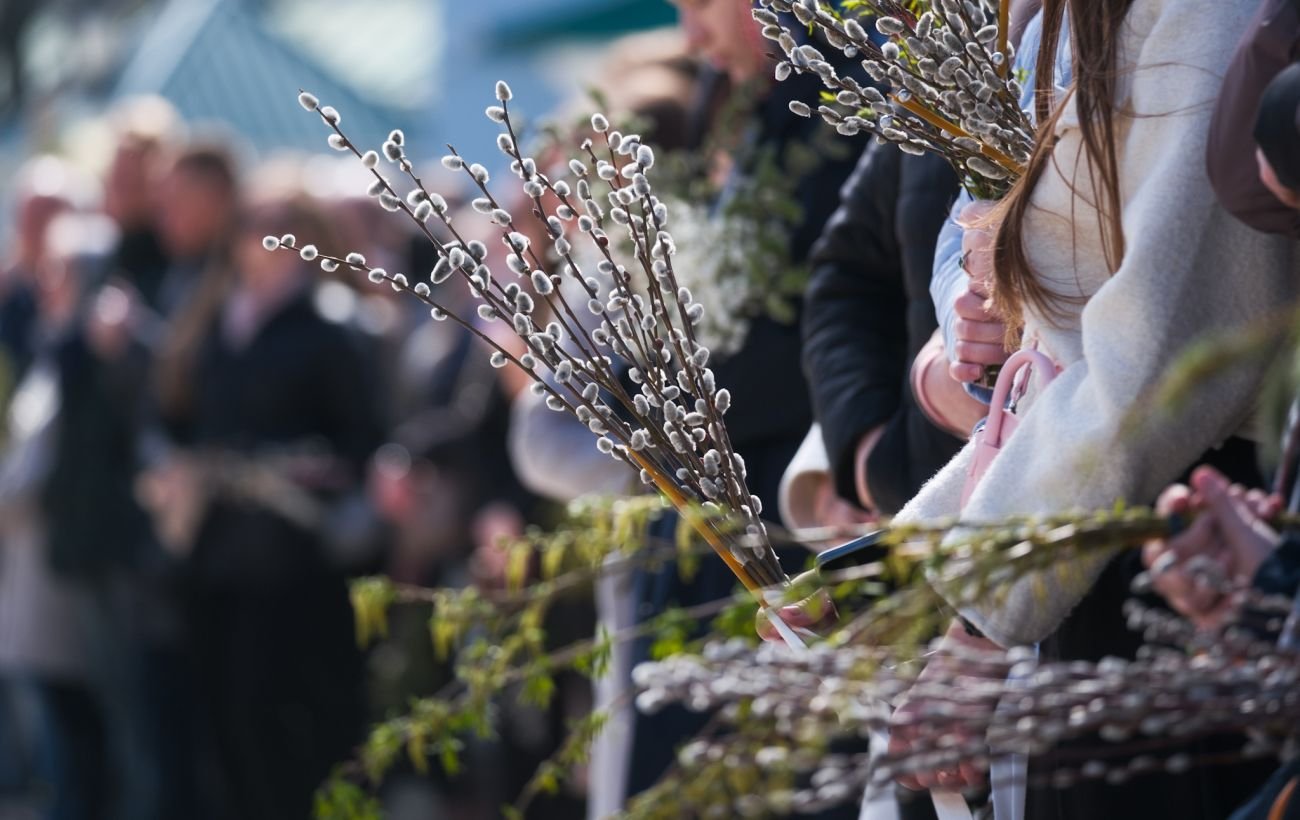
Willow branches for Ukrainians instead of palm leaves
Tomorrow, April 5, Ukrainians will celebrate one of the biggest holidays of the year, known as Palm Sunday. The true meaning of this day is much deeper than it may seem at first glance.
This was reported by RBC-Ukraine, citing a publication from the press service of the Orthodox Church of Ukraine (OCU) on Facebook.
Also read: Not only Holy Week and Easter: what are the most important days in the OCU calendar in April
Main points:
- Different names for one holiday: the 6th Sunday of Great Lent is not just Palm or Willow Sunday.
- Depth of meaning: on this day, the OCU remembers an important biblical event for all humanity.
- Calendar “boundary”: after Palm Sunday, the strictest week before Easter, Holy Week, begins.
- Symbolic replacement: Ukrainians go to churches with willow branches instead of “traditional” palm leaves.
- OCU services: Ukrainians are invited to churches not only tomorrow but also today.
What holiday is celebrated on Palm Sunday
Ukrainians were informed that on Sunday, April 5, the OCU will celebrate the Feast of the Lord’s Entrance into Jerusalem.
This event is also referred to as:
- the Sunday of Palms (from the Greek word βαΐα – “palm branch”);
- Willow Sunday;
- the Sunday of Flowers.
 This year, Palm Sunday falls on April 5 (infographic: facebook.com/Orthodox.in.Ukraine)
The OCU reminded that this holiday:
- marks the end of the sixth (and last) week of Holy Lent;
- signals the beginning of Holy Week.
What biblical event is remembered on this day
According to the OCU, all four evangelists recount the well-known biblical event that is remembered on Palm Sunday.
And it occurred in spring – six days before the Old Testament Passover.
“Not long before this, the Lord Jesus Christ performed one of His greatest miracles: He raised the righteous Lazarus, who had been in the tomb for four days,” the OCU reported.
It is noted that “the news of the unprecedented miracle performed in Bethany (near Jerusalem) spread throughout the region,” as “everyone wanted to see the great Miracle Worker and Messiah.”
And so the Lord, “as if responding to the people’s desire,” went to Jerusalem – “to fulfill all prophecies about Him as the Messiah.”
“He knows He is going to His death, but by willingly going to suffer, the Lord shows that He accepts it not because He cannot defend Himself from His enemies, but because He fulfills the will of His Heavenly Father and consciously offers Himself as a sacrifice for the salvation of humanity,” the OCU explained.
Where the name “Palm Sunday” comes from
In many languages around the world, the Feast of the Lord’s Entrance into Jerusalem is also called Palm Sunday.
It was with the leaves of this exotic plant for our country that the residents of Jerusalem once welcomed Jesus Christ (reportedly holding palm branches and laying them on the road).
Subsequently, the tradition of blessing green branches emerged, which is considered a symbol of:
- Christ’s victory over death;
- the glorification of the great voluntary sacrifice He made for human salvation.
Since in our latitudes, it is usually willow that blooms at this time, branches of it began to be brought to churches for blessing.
Thus, the name arises – Palm Sunday or Flower Sunday (as willow is the first plant to “wake up” and bloom in spring).
When the holiday began to be celebrated and how it is done now
“The Feast of the Lord’s Entrance into Jerusalem has been celebrated since the times of the ancient Church,” Ukrainians were told.
It is specified that “the first mentions of it are known from the 3rd century.”
Now, this holiday is among the 12 most important celebrations in the liturgical calendar.
“The evening before, a vigil is held, and on the day of the feast – a Divine Liturgy according to the rite of St. John Chrysostom,” the OCU reported.
It is noted that the clergy are dressed in festive green vestments during this time.
At the conclusion of the solemn service on the day of the Feast of the Lord’s Entrance into Jerusalem, the clergy sprinkle all those present and the willow branches that the faithful bring to the church with blessed water.
Therefore, all Ukrainians are sincerely invited to the OCU churches for the festive service:
- on the evening of Saturday, April 4 (today);
- on Sunday, April 5 (tomorrow).
We remind you that we previously reported when Catholics and Orthodox Christians should celebrate Easter 2026 (the OCU explained the difference in dates).
Additionally, Ukrainians were informed whether an online broadcast can replace going to church.
Also read whether confession is mandatory “for Easter” – when and how to repent of sins.


