
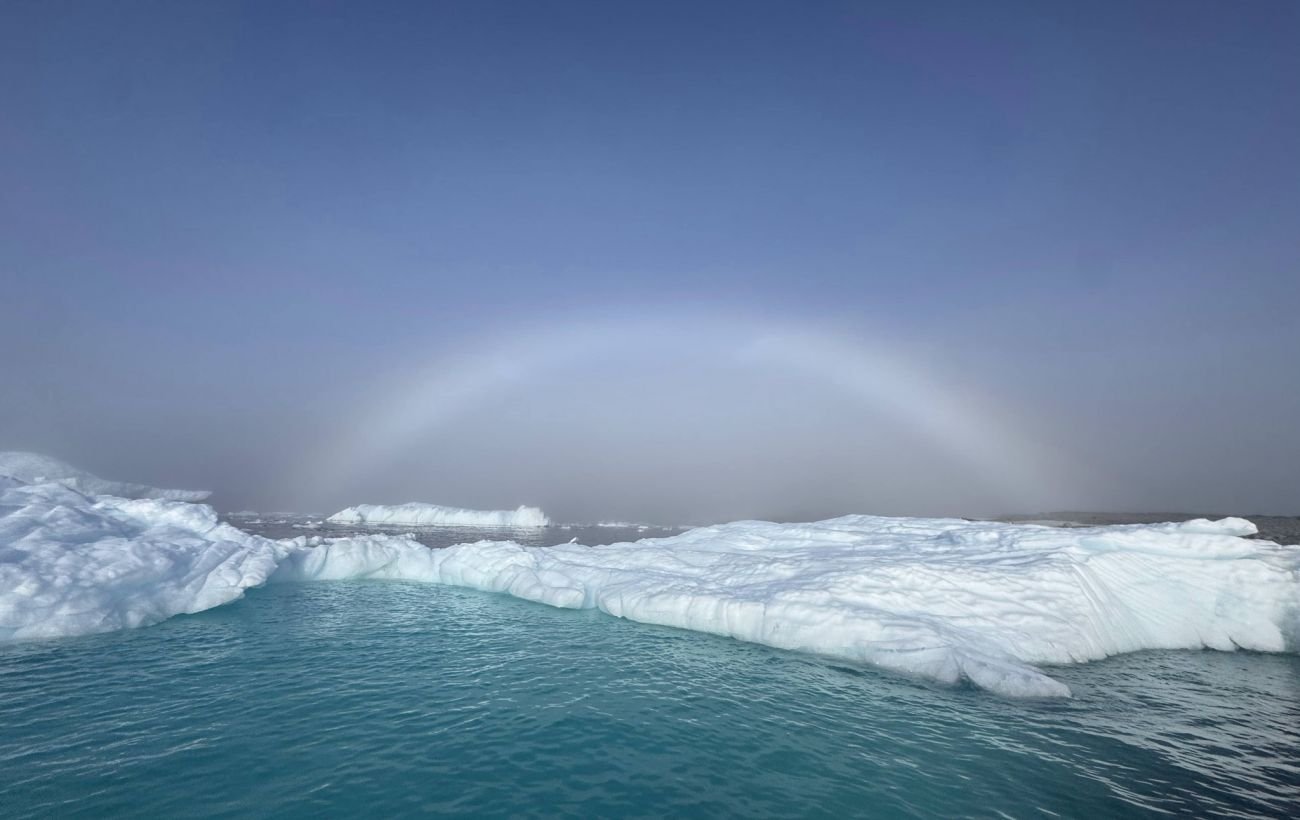
Polar explorers shared photos of a “foggy” rainbow
Ukrainian scientists showcased a white rainbow captured near the Akademik Vernadsky station. This rare natural phenomenon is explained by the size of water droplets in the air.
This was reported by RBC-Ukraine, citing the National Antarctic Scientific Center.
Read also: “If Antarctica melts, cities will go underwater.” An interview with a polar explorer about working at the edge of the world
Main points:
- Rare phenomenon: A white rainbow, also known as a “foggy” rainbow, was recorded near the Akademik Vernadsky station.
- Cause of appearance: Unlike a regular rainbow, this one occurs due to microscopic water droplets in fog.
- Authorship: The unique images were taken by biologist Zoya Shvydka from the 30th Ukrainian Antarctic expedition.
- Appearance: Such a rainbow may sometimes have a barely noticeable orange or violet hue at the edges.
Why does a rainbow turn white
Researchers explain that in a classic rainbow, light passes through relatively large water droplets. In them, white light is separated into distinct colors, which do not mix together – hence we see a bright spectrum.
However, if the droplets are very small, a different process occurs. Light beams mix due to strong diffraction, and colors gradually lose their vibrancy. As a result, the rainbow appears pale or almost white.
The unusual natural phenomenon was photographed by biologist Zoya Shvydka from the 30th Antarctic expedition.
White rainbow (photo: Zoya Shvydka)
Where can such a phenomenon be seen
A white rainbow is often referred to as foggy. It occurs when sunlight passes through a light fog made up of microscopic water droplets.
Sometimes the edges of such a rainbow may have a slight tint: the outer edge is orange, while the lower edge is violet.
Earlier, RBC-Ukraine reported on how Ukrainian polar explorers count penguins in Antarctica. Scientists use various methods – foot patrols and drones – to count not only the birds but also nests, eggs, and chicks, as well as to monitor climate changes.
We also wrote about the living conditions of Ukrainian polar explorers at the Akademik Vernadsky station. This includes how they work and live in almost complete isolation: enduring polar nights, strong winds, conducting scientific research, maintaining daily life, and even celebrating holidays far from home.
Source: rbc.ua +rel=”nofollow”


