
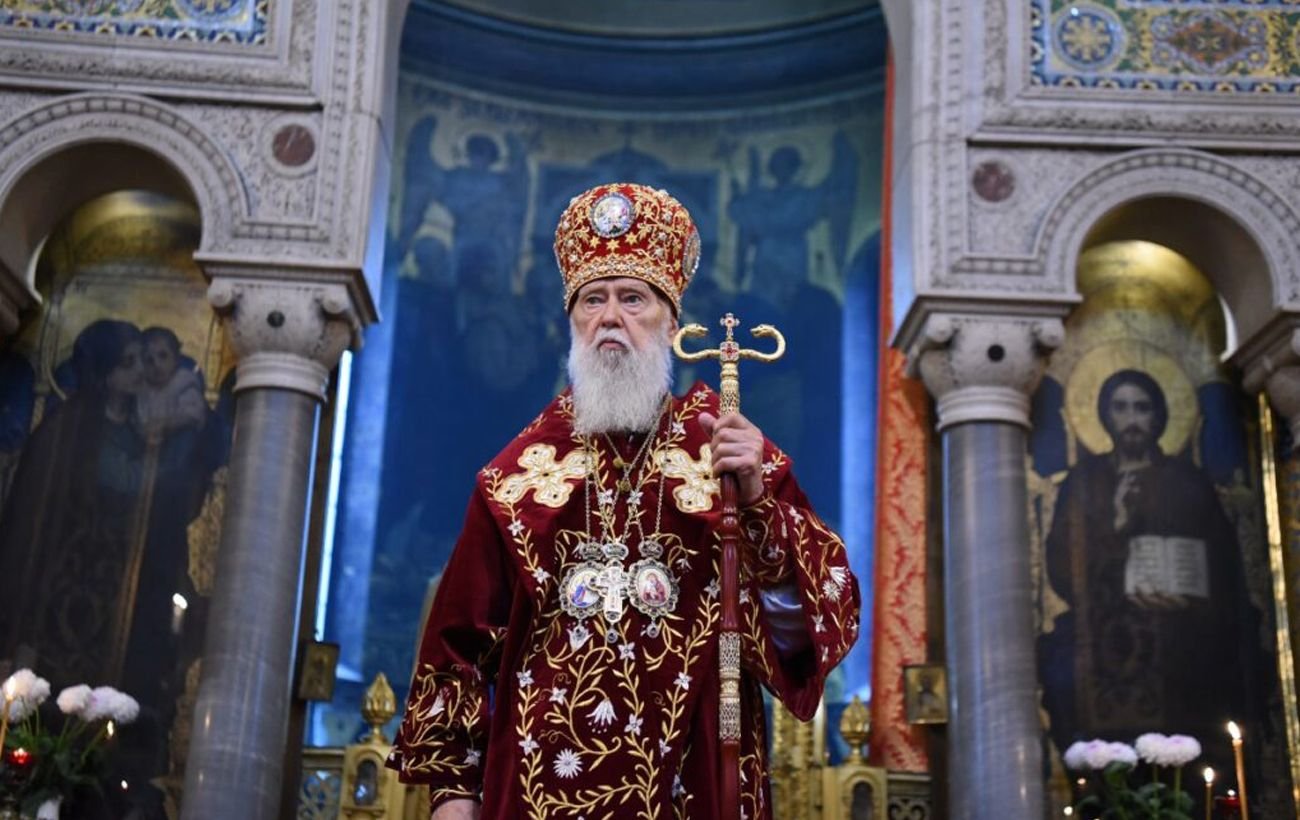
He had every chance to lead the Moscow Patriarchate, but he chose the fight for an independent church
Patriarch of the Orthodox Church of Ukraine Filaret (birth name: Mikhail Antonovich Denisenko) has passed away at the age of 97.
RBK-Ukraine reports on this and recounts the path of the honorary patriarch.
Also read: Filaret made a will with a sudden prohibition for the OCU
The death was announced by the head of the OCU, Metropolitan Epiphanius.
“Today, in my heart, as in the hearts of many Ukrainians, there is deep sorrow and grief, for today the earthly journey of His Holiness Patriarch Filaret has come to an end,” he wrote.
The metropolitan urged the entire Ukrainian flock to offer heartfelt prayers for the repose of Patriarch Filaret’s soul.
“We will always remember Patriarch Filaret’s teachings on the importance of maintaining the unity of the Ukrainian Church around the Kyiv Throne,” noted Epiphanius.
Filaret was a Ukrainian Orthodox archbishop who led the Kyiv Patriarchate from 1995 to 2018 with the title of Patriarch of Kyiv and all Rus-Ukraine. Since December 2018, he held the title of Honorary Patriarch of the Orthodox Church of Ukraine. In 2019, he was awarded the title of Hero of Ukraine.
Childhood and Education
The future patriarch was born in the village of Blahodatne in the Donetsk region. After school, in 1946, he entered the Odessa Theological Seminary, graduating with honors. In 1952, he completed his studies at the Moscow Theological Academy and received a degree of Candidate of Theology.
Beginning of Church Service
On January 1, 1950, he took monastic vows under the name Filaret. Just 15 days later, he was ordained as a hierodeacon, and in June 1951, as a hieromonk. From 1953, he taught at the Moscow Theological Academy, and in 1956, he was appointed inspector of the Saratov Theological Seminary, being elevated to the rank of igumen. Later, he was transferred to Kyiv, where he became the inspector of the theological seminary and from 1958 served as its rector in the rank of archimandrite.
Service in Ukraine and Abroad
In 1960, Filaret was appointed manager of the affairs of the Ukrainian Exarchate and rector of the St. Vladimir Cathedral in Kyiv. In 1961-1962, he served as the rector of the representation of the Russian Orthodox Church at the Alexandrian Patriarchate in the city of Alexandria (Egypt).

Filaret was born in the Donetsk region (facebook.com/KyivPatriarchate)
On January 12, 1962, by the decree of His Holiness Patriarch Alexy and the Holy Synod, Archimandrite Filaret was elected Bishop of Luga, vicar of the Leningrad Diocese, with the task of managing the Riga Diocese. He later became the Bishop of Vienna and Austria. In December 1964, he was appointed Bishop of Dmitrov, vicar of the Moscow Diocese, and rector of the Moscow Theological Academy and Seminary.
On May 14, 1966, he was elevated to the rank of archbishop and appointed Exarch of Ukraine, Archbishop of Kyiv and Galicia, and a permanent member of the Holy Synod.
In 1968, Patriarch Alexy elevated him to the rank of metropolitan. Three years later, he received the right to wear two panagias.
Struggle for the Independence of the Ukrainian Church
In the 1970s and 1980s, Metropolitan Filaret was actively involved in church public life. After the death of Patriarch Pimen in 1990, Filaret became the Locum Tenens of the Moscow Patriarchal Throne and chaired the Local Council of the Russian Orthodox Church.
He initiated the proposal to grant the Ukrainian Orthodox Church independence in governance, and in the autumn of that year, the Hierarchical Council made this decision. Filaret was elected the head of the UOC with the title of Metropolitan of Kyiv and all Ukraine.
After Ukraine declared independence in 1991, Filaret convened the All-Ukrainian Council, which proclaimed the autocephaly of the UOC. However, the Russian Orthodox Church did not agree with this. In 1992, a council of the Russian Orthodox Church took place in Kharkiv, electing Metropolitan Vladimir (Sabodan). Filaret refused to recognize him and called the decision non-canonical.
In June 1992, the All-Ukrainian Local Council announced the establishment of a unified Ukrainian Orthodox Church of the Kyiv Patriarchate. In 1995, Filaret was elected its patriarch. He actively advocated for the autocephaly of the Ukrainian church and initiated the translation of liturgical books into the Ukrainian language.
Transition to the OCU
On December 15, 2018, a Unifying Council was held in Kyiv, during which the Orthodox Church of Ukraine was established. Filaret did not nominate himself for the head position. After the election of Metropolitan Epiphanius, he was proclaimed the spiritual mentor of the OCU and received the title of honorary patriarch.
Awards
Filaret is an honorary member of the Moscow and Leningrad Theological Academies and holds an “honoris causa” title from several foreign educational institutions.
He has been awarded the highest honors of the Russian Orthodox Church and other Orthodox churches, as well as state orders, including the Order of Friendship of Peoples, the Order of the Red Banner of Labor, the Order of Freedom, and the Ivan Mazepa Cross. He is a full cavalier of the Order of Yaroslav the Wise. In 2019, he was awarded the title of Hero of Ukraine.

